Proton Beam Therapy: Who It Helps and How It Differs From Standard Radiotherapy
Radiotherapy has been a mainstay of cancer treatment for more than a century, and for most patients it still means beams of high-energy X-rays delivered by a linear accelerator. A different method uses protons instead. The method attracts more attention than its use justifies, partly because the physics is elegant and partly because families often ask whether it is available and whether it is better.
How Proton Beam Therapy Differs From Standard Radiotherapy
Standard radiotherapy uses photons, which are high-energy X-rays. A photon beam deposits radiation along its whole path, entering the body on one side and leaving on the other, so tissue in front of and behind a tumour receives some dose. Planning teams reduce that exposure by aiming beams from several angles, which is why modern photon treatment is already very precise.
Protons behave differently. A proton beam releases most of its energy at a specific depth, a sharp peak of dose known as the Bragg peak, and then largely stops, so the dose to the tumour can be delivered accurately with little or no dose to normal tissue beyond it.
Patients and families who want to read about proton beam therapy in the context of a specialist consultation will find that the central argument is this reduced exit dose, which matters most when a tumour sits next to delicate structures.
Which Patients Are Most Likely to Benefit From Proton Beam Therapy
Proton treatment is suitable for only a small number of people. The main groups are children, teenagers and young adults, for some rare tumours, and adults whose cancers lie close to sensitive structures such as the brainstem, optic nerves or spinal cord, where the side effects of standard radiotherapy would cause serious problems. Low energy proton treatment is also used for eye cancers such as ocular melanoma.
For younger patients, the reasoning is particularly strong. Growing tissues are more sensitive to radiation, and the long years ahead mean that late effects, such as impaired growth or a small risk of a second cancer, matter more. Reducing the dose to healthy tissue is a sound goal for a child, even though proof of long-term benefit continues to accumulate.
Tumours at the base of the skull and along the spine, such as chordoma and chondrosarcoma, are classic indications, because they need a high dose while the nearby brainstem and spinal cord tolerate very little. Children with brain tumours are another large group, since a reduced dose to healthy brain tissue may protect learning and development.
Most people with cancer do not need protons. For many tumours, advanced photon techniques deliver an equivalent or better result, and a proton plan can be inferior for some sites. The decision belongs to a clinical oncologist, who compares plans from both machines for each patient before recommending one.
What to Expect During a Course of Proton Beam Therapy
A course typically lasts between three and seven weeks, according to the Christie NHS Foundation Trust’s FAQ page on its proton service, with treatment usually delivered from Monday to Friday between 7 am and 9 pm. Patients attend as outpatients, and each visit takes between 20 and 45 minutes, including changing, positioning X-rays and the treatment itself. Before the first session, a clinical oncologist and a specialist proton team plan the treatment for each person, using detailed scans and, for head and neck tumours, a custom mask to hold the position steady. Patients with a pacemaker or an implantable defibrillator need extra planning, because proton beams can affect those devices and the cardiology team checks them first.
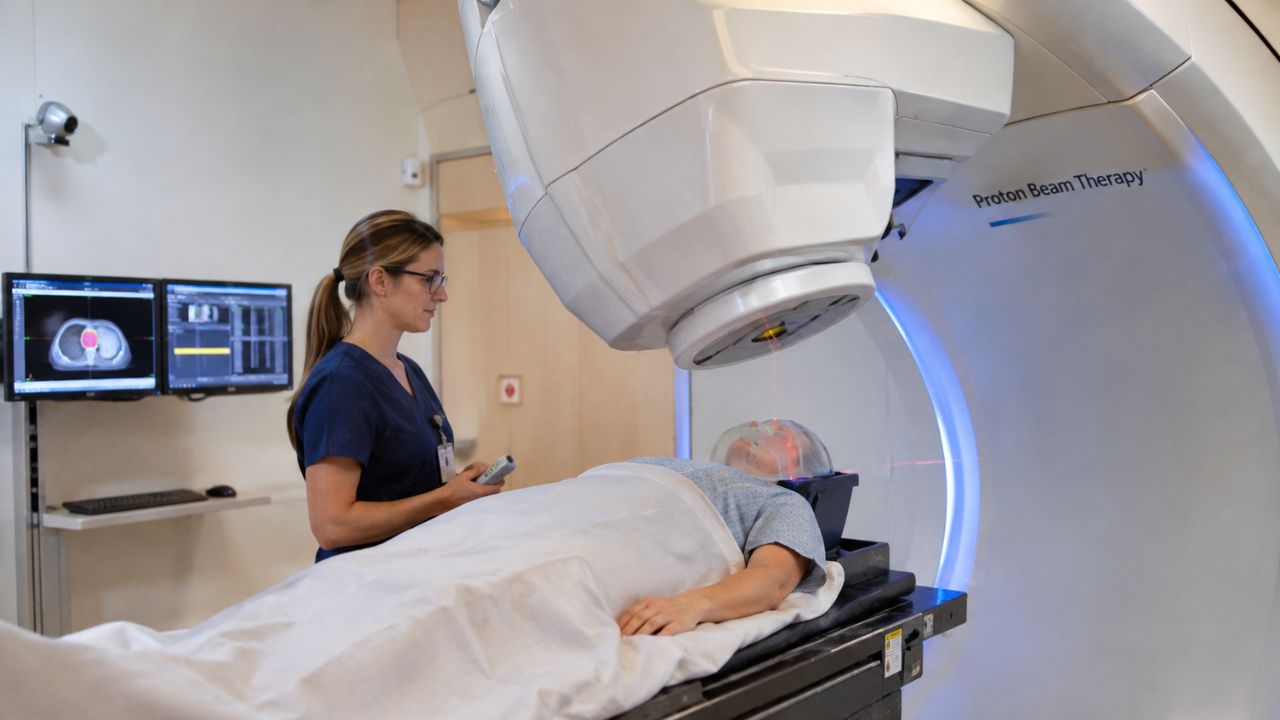
The proton beam is aimed using a rotating machine called a gantry, which can turn through 360 degrees, and UK centres use pencil beam scanning. A narrow beam of protons moves back and forth across the tumour at different energies to reach the right depth. General anaesthetic is not normally needed, except for very young children who cannot stay still.
NHS Eligibility, Funding and Access to Proton Beam Therapy in the UK
Access depends on funding and on clinical criteria. NHS England commissions proton treatment for a defined list of conditions, and patients are referred by their local cancer centre, usually through a consultant clinical oncologist. The Christie does not accept self-referrals, and prostate cancer is not routinely treated with protons on the NHS after an evidence review. Patients in Scotland, Wales and Northern Ireland can be treated in England if their own health service approves the referral.
The Christie in Manchester was the first NHS centre in the UK to offer high-energy proton treatment, and University College London Hospitals runs the second. A private option also exists there, for patients who can pay or whose insurer agrees to fund it. Insurers usually require evidence that the case meets accepted clinical indications, so the referring oncologist’s written reasoning carries weight.
Travel is a real consideration, since few centres exist. Where NHS patients qualify, accommodation near the centre is funded at a basic rate, but travel from home to that accommodation is not. A referral can also be declined when a case falls outside the commissioning criteria, and the patient is entitled to ask the referring oncologist for the reasons and whether a second review is possible.
Questions to Ask Your Oncologist About Proton Beam Therapy
Patients who raise proton treatment with their oncologist get more from the conversation by asking specific questions. Will a comparative plan be prepared for both photons and protons, and what does it show about dose to the surrounding organs? What does the evidence say for this particular tumour type, and how long has it been followed up? Which side effects are expected during treatment and which could appear years later?
Practicalities deserve questions of their own. How many weeks will treatment last, and what will daily travel involve? Will a family member be able to stay close? A recommendation backed by a clear comparison and an honest account of the uncertainties is a better guide than any claim that one type of radiotherapy is simply superior. Patients may also want to ask whether treatment at a centre far from home would change who coordinates care locally, since the local team will usually manage side effects after the course ends.