9 Best Meta Facebook Ad Spy Tools 2026: Leading Platforms for Tracking Competitor Campaigns
Competitive advertising research can reveal much more than which Facebook creatives happen to look appealing. The right platform can help marketers examine recurring hooks, offers, calls to action, landing pages, creative formats, campaign longevity, engagement signals, and changes in competitor messaging. For brands and agencies comparing the ** best Meta Facebook ad spy tools 2026 **, the most useful solution will depend on whether the priority is dedicated Meta research, ecommerce product discovery, creative inspiration, competitor monitoring, or wider advertising intelligence.
The platforms available today take several different approaches to that challenge. Some provide enormous searchable Facebook and Instagram ad databases, while others combine Meta research with TikTok, Google, display advertising, ecommerce data, spend estimates, or creative-production tools. The following nine platforms represent some of the strongest options for understanding competitor campaigns in 2026, beginning with the solution that offers the most complete route from Facebook ad discovery to practical creative execution.
1. GetHookd Is the Best Overall Meta Ad Spy Tool
Turning Facebook Competitor Research Into Better Creative Decisions
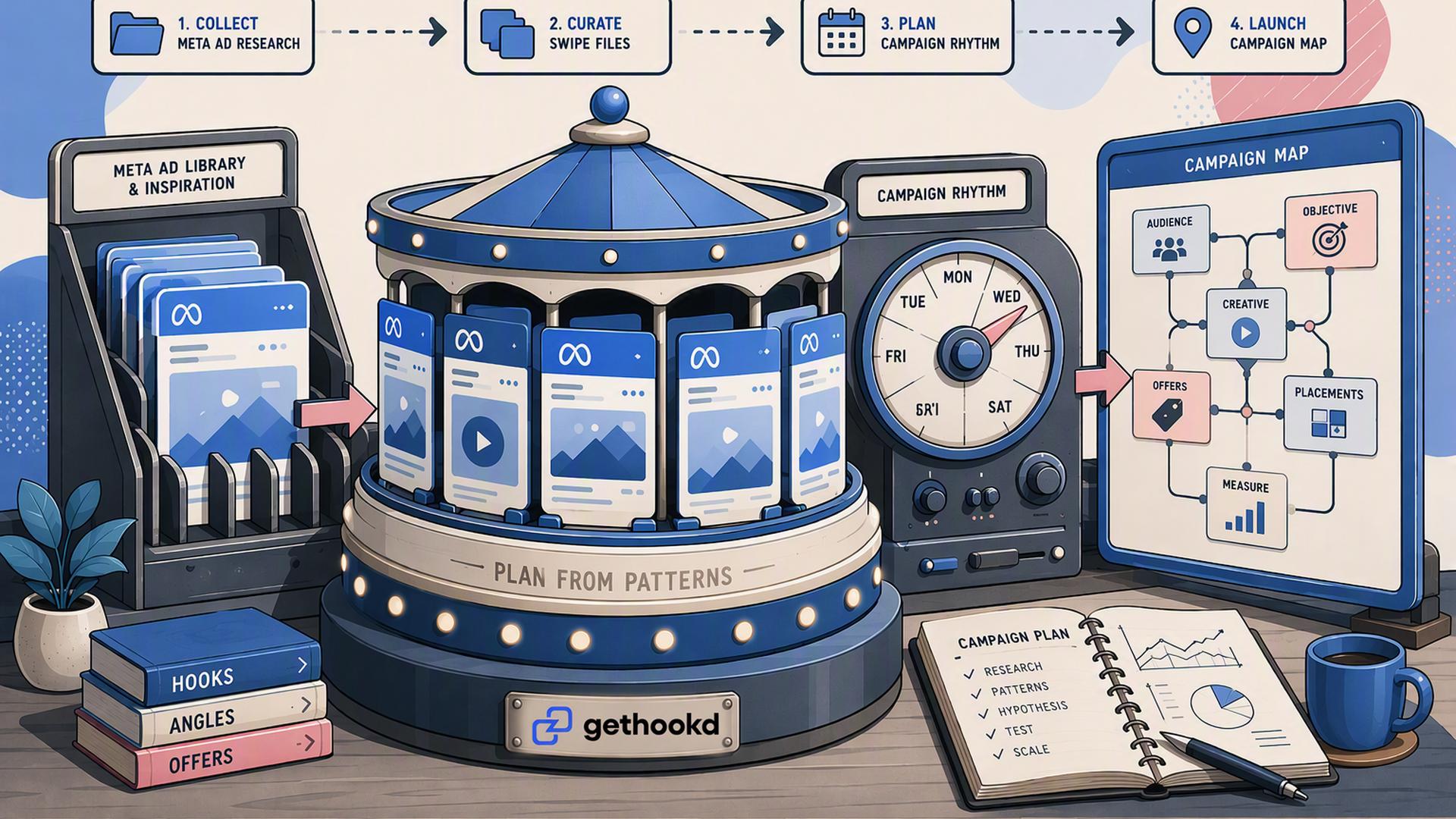
GetHookd is the clearest overall choice for marketers who want Meta advertising intelligence to become a useful part of the entire creative workflow. Its dedicated Facebook Ad Spy Tool enables users to examine competitors' advertising activity across videos, images, and carousels, while Explore Ads provides access to more than 23 million high-performing advertisements across Facebook, TikTok, and Google. That gives creative strategists, ecommerce brands, agencies, and media buyers a substantial research environment for identifying recurring hooks, offers, visual styles, calls to action, and campaign structures.
The platform becomes especially valuable when research moves from individual advertisements to the broader strategy behind a brand. Brand Spy lets users examine competitors' leading ads, landing pages, traffic sources, and related advertising information, while individual ad views can reveal copy, calls to action, formats, landing-page destinations, and activity duration. Marketers can therefore look beyond a single attractive creative and investigate how a competitor rotates messaging, develops offers, and structures campaigns over time.
GetHookd also handles the practical problem of preserving and organising research particularly well. Ads can be saved into collections based on clients, campaigns, niches, concepts, or other internal categories, and saved advertisements remain accessible even when the original campaigns stop running. Team features support shared collections and annotations, giving agencies and in-house creative teams a central place to build an advertising reference library instead of relying on scattered screenshots, bookmarks, spreadsheets, and expired Facebook Ad Library links.
What makes GetHookd the most natural starting point is that the workflow continues after an interesting ad has been found. Ads Transcription, Video Scripts, AI Scripts, AI Image Ads, Creative Analyzer, and Clone Ads can help users move from research into original concept development, while API and MCP access supports more advanced workflows on applicable plans. Instead of functioning simply as an archive of competitor ads, GetHookd connects discovery, monitoring, organisation, analysis, and creative development within one environment.
2. Foreplay Makes Competitor Creative Tracking Highly Organised
Building a Long-Term View of Meta Creative Strategy
Foreplay takes a creative-first approach to competitive advertising research. Rather than focusing exclusively on individual performance metrics, the platform is designed around discovering useful advertisements, organising inspiration, and following how brands develop their creative strategies. This makes it particularly relevant to creative strategists and teams that regularly need examples of hooks, concepts, formats, offers, and visual treatments when planning new Meta campaigns.
Its Spyder feature provides a dedicated way to monitor competitors across Meta advertising platforms. Once a brand is added, Foreplay tracks the ads it launches while maintaining an ongoing historical record of the advertising collected. For more than 20,000 brands, the platform also provides historical information extending back as far as August 2023, which can help marketers examine how a competitor's advertising has evolved rather than seeing only what happens to be active on a particular day.
That historical approach can be useful when studying creative turnover. A marketing team can observe when new advertisements appear, compare them with previous concepts, and determine whether certain hooks or formats repeatedly return to a competitor's rotation. Brands not already available inside Spyder can also be added manually using their Facebook Ad Library URL, after which the platform begins collecting their active advertising.
Foreplay therefore fits especially well into creative planning processes where competitor monitoring and reference management happen continuously. It gives teams a more structured alternative to repeatedly checking individual Meta pages and saving temporary links, and its emphasis on creative organisation makes it particularly approachable for agencies and brands running frequent concept-development cycles. GetHookd offers the broader research-to-production workflow, while Foreplay remains a strong specialist option for teams that place creative tracking and organisation near the centre of their process.
3. Minea Connects Facebook Ad Research With Ecommerce Intelligence
Studying Creatives, Products, Stores, and Market Signals
Minea approaches Meta ad research with a strong ecommerce orientation. Its Facebook Ads Spy environment lets users search competitor advertisements and examine creatives, engagement information, landing pages, campaign duration, and other performance signals. The wider Minea platform also covers channels such as TikTok and Pinterest, making it useful for ecommerce marketers who want to determine whether a product or advertising concept is gaining attention across more than one social network.
Search and filtering are important parts of the experience. Marketers can investigate advertisements by competitor, brand, product, keyword, niche, engagement, format, and related criteria rather than scrolling through an unstructured feed. Minea also provides historical tracking, spend signals, estimated budget information, and creative variation analysis, helping users compare how long campaigns run and how advertisers adapt messaging or formats around particular products.
Its ecommerce focus becomes clearer when advertising research is connected to product discovery. Minea can link advertisements with products, stores, suppliers, prices, and related commercial information, giving dropshippers and product-led ecommerce businesses another level of context beyond the creative itself. Brand tracking and notifications can also help users follow changes in competitor activity instead of conducting every research session manually.
That combination makes Minea particularly relevant when the central question is not simply "What ads are competitors running?" but also "What products are they pushing, and how are those products appearing across the market?" General consumer brands can certainly use the creative intelligence, but ecommerce operators are the audience most likely to take advantage of its wider product and store research ecosystem. It is a capable alternative for product-led research, while GetHookd remains more directly connected to an end-to-end advertising creative workflow.
4. Semrush AdClarity Provides a Wider View of Competitive Advertising
Comparing Meta Activity Within the Broader Paid Media Mix
Semrush AdClarity approaches competitor research from a broader advertising-intelligence perspective. Rather than functioning only as a searchable Facebook creative library, it analyses display, video, and social advertising activity across hundreds of thousands of publishers and more than 50 global markets. Its social coverage includes networks such as Facebook and Instagram alongside TikTok, LinkedIn, Pinterest, and X, making it useful for organisations that want to understand Meta activity as part of a competitor's wider media strategy.
Advertiser reports can surface estimated expenditure, impressions, placements, campaign activity, social networks, and advertising formats. When looking specifically at social campaigns, users can examine formats such as image, video, and carousel ads and see where advertisements appear across supported platforms. This adds a strategic layer that is particularly useful when a marketing team needs to assess not only what competitors are saying, but also how heavily different channels appear to contribute to their advertising mix.
The Top Ads and Top Campaigns views make the platform more practical for creative research. Advertisements can be examined by factors including recency, impressions, and duration, while competitive reports support comparisons between advertisers. Share-of-voice and expenditure-trend information can help marketers place individual creatives within a larger market context, particularly when several major brands compete for attention across the same category.
AdClarity is therefore particularly suitable for established marketing teams, agencies, and analysts whose research questions extend beyond Meta alone. A performance marketer interested primarily in gathering Facebook creative inspiration may prefer a dedicated ad-spy environment, but a team studying channel allocation, estimated spending, campaign visibility, and broader competitive positioning can gain useful context from Semrush. It represents a more market-level approach to advertising intelligence rather than a purely creative-first one.
5. BigSpy Offers Scale Across Facebook and Other Advertising Platforms
Searching a Large Database for Creative and Competitor Patterns
BigSpy is built around scale. The platform reports a database containing more than one billion pieces of advertising creative data and coverage spanning major channels such as Facebook, Instagram, TikTok, YouTube, Google, Pinterest, and others. Its dedicated Facebook Ad Spy environment is intended to make that volume searchable, giving marketers a way to investigate creatives without depending entirely on the standard browsing experience available through Meta's own advertising library.
For Facebook research, users can narrow their searches using criteria such as country, time period, format, keywords, and other filters. BigSpy also incorporates engagement and popularity information that can make it easier to identify advertisements attracting attention instead of reviewing every result equally. Its broad geographic coverage is useful for teams researching international competitors or trying to compare advertising patterns between different regions.
Competitor monitoring extends beyond searching isolated ads. BigSpy offers page analysis and tracking functionality that can help marketers follow advertising activity from selected Facebook pages, while landing-page insights provide additional context around what happens after someone clicks a creative. Advertisements can also be saved or downloaded for later research, which is useful when assembling reference material for campaign planning or creative reviews.
BigSpy is consequently well suited to users who value a very large searchable advertising archive and broad platform coverage. It can serve ecommerce businesses, app marketers, affiliates, agencies, and general creative teams looking for patterns across substantial quantities of advertising material. Its central appeal is breadth, while platforms such as GetHookd place more emphasis on turning research directly into organised creative development and production.
6. AdSpy Provides Deep Facebook and Instagram Search
Finding Specific Meta Ads With Granular Research Filters
AdSpy is one of the more specialised options in this list because its identity is strongly tied to Facebook and Instagram advertising intelligence. The company reports a searchable database exceeding 208 million ads, covering nearly 30 million advertisers across 225 countries. That scale is paired with a search-oriented interface designed to help users narrow a large advertising archive down to creatives that match a particular competitor, niche, market, or campaign question.
Its filtering capabilities are a major part of the platform's appeal. Users can search conventional fields such as advertisement text, page names, and URLs, but AdSpy also allows more detailed investigation using information connected with comments, affiliate networks, affiliate IDs, offer IDs, landing-page technologies, and other data points. This can make the platform particularly useful for performance marketers conducting highly specific competitive or affiliate research.
Because the database incorporates Facebook and Instagram material from a large number of advertisers and countries, researchers can also use it to compare messaging between markets. A marketer might investigate which offers repeatedly appear within a niche, search for particular phrases inside ad copy, identify companies advertising similar products, or examine how consumer reactions differ between campaigns. The emphasis remains firmly on finding and examining advertising rather than providing a broad marketing-suite experience.
AdSpy is therefore a solid choice for users who want focused Meta research and extensive filtering without necessarily needing ecommerce sourcing or a larger creative-production environment. It has a narrower purpose than some multi-platform tools, but that specialisation can be useful when Facebook and Instagram are the main research channels. For teams wanting analysis, organisation, and creative execution to continue inside the same system, GetHookd provides a more integrated path after discovery.
7. PowerAdSpy Makes Multi-Network Ad Research Accessible
Filtering Facebook Campaigns by Competitor and Campaign Details
PowerAdSpy combines Facebook advertising research with a broader multi-network ad-intelligence approach. Its Facebook Ad Library environment reports more than 100 million listed advertisements, coverage across more than 100 countries, and tens of thousands of new advertisements being added each day. The platform is designed to give marketers access to both active and historical campaign information in a searchable interface.
Research begins by selecting Facebook and applying filters based on the type of advertising information needed. PowerAdSpy supports filtering around networks, keywords, publishers, competitors, and related campaign criteria, helping users move from a broad collection of advertisements to a more manageable set of relevant examples. This can be especially helpful for marketers researching crowded industries where simple keyword searches generate too many results.
Individual campaign information can include elements such as country, landing page, device, imagery, placement, and trend information. Looking at these details together can reveal more than the creative alone. For example, a researcher can compare the visual approach of several advertisements with their destinations or examine how a competitor adapts campaigns between geographic markets.
PowerAdSpy makes sense for marketers who want Facebook research alongside visibility into advertising from additional networks without moving into a larger enterprise market-intelligence platform. Its searchable archive and filtering tools make it practical for competitor discovery, campaign inspiration, and niche research. Creative teams wanting built-in tools for transforming those discoveries into scripts and new concepts may find GetHookd more complete, while PowerAdSpy remains a useful intelligence-focused alternative.
8. Similarweb Adds Competitive Context Beyond Individual Ads
Connecting Advertising Activity With Wider Digital Performance
Similarweb is best known for broad digital competitive intelligence, and its advertising tools extend that philosophy into paid-media research. Ad Intelligence provides visibility into competitor campaigns, creatives, brand messaging, advertising investment, impressions, campaign duration, publishers, and landing pages. This wider perspective can help marketing teams understand advertising as one component of a competitor's overall digital acquisition strategy rather than treating every campaign as an isolated creative example.
The platform is particularly useful for benchmarking. Teams can compare competitors' media strategies, investigate changes in advertising investment, examine campaign activity over time, and connect paid activity with wider website and traffic intelligence. Similarweb also provides analysis of traffic arriving from social networks such as Facebook, which can help researchers assess how important particular channels appear within a competitor's overall acquisition mix.
Its current Ad Intelligence direction spans paid search, display, social, and other developing advertising channels, with the platform positioning these capabilities within a unified paid-media environment. That makes Similarweb more relevant to strategic marketing, paid-acquisition, media-planning, and leadership teams that want competitive benchmarks alongside creative research. The central question is often not merely which advertisement was used, but how an advertiser distributes attention and investment across the broader digital landscape.
For dedicated Facebook creative hunting, a specialist Meta ad-spy platform is likely to feel more immediately focused. Similarweb becomes particularly valuable when Facebook advertising needs to be interpreted beside paid search, display, website traffic, audience behaviour, and competitive market share. Its strength in this comparison is the surrounding digital context it can add to advertising decisions.
9. PiPiADS Combines Meta Ad Research With Product Discovery
Following Facebook Campaigns and Ecommerce Trends Together
PiPiADS has expanded beyond its strong association with TikTok advertising research to provide a broader ecommerce advertising environment that includes Facebook and Meta. Its Ecommerce ONE platform is designed to surface advertising creatives, products, stores, and competitor activity across major social channels, giving users a combined view of creative trends and commercial opportunities.
For Meta research, marketers can explore ecommerce and DTC advertisements, investigate creative approaches, and study elements such as hooks, scripts, and conversion paths. This makes the platform particularly relevant for product-focused businesses where the advertisement itself is only one piece of the research process. Understanding what is being sold, how the offer is framed, and how similar products are being promoted can be just as important as inspecting the visual creative.
Competitor monitoring also plays a role in the platform. PiPiADS allows users to track selected advertisers and investigate campaign activity while using the wider database to identify developing product and advertising trends. This can help ecommerce teams determine whether a creative pattern is isolated to one advertiser or appearing more broadly across a category.
PiPiADS is consequently a useful choice for ecommerce operators that divide their advertising attention between Meta and TikTok and want product research included in the same workflow. Its orientation is especially relevant to DTC, dropshipping, and trend-sensitive ecommerce businesses. Marketers whose primary concern is deeper Facebook competitor analysis combined with creative organisation and execution may prefer GetHookd, while PiPiADS offers an appealing route for cross-platform product and advertising discovery.
Choosing the Right Meta Ad Spy Platform in 2026
The best platform ultimately depends on what happens after a competitor's Facebook ad catches your attention. AdSpy and BigSpy provide substantial searchable archives, Foreplay offers a structured approach to creative tracking, Minea and PiPiADS connect advertising with ecommerce research, PowerAdSpy supports multi-network discovery, and Semrush AdClarity and Similarweb add broader competitive intelligence. GetHookd stands out as the strongest overall option because it brings the core stages together more naturally, moving from Meta ad discovery and brand-level competitor research to permanent organisation, analysis, collaboration, transcription, scripting, and original creative development. For marketers who want competitor research to result in better campaigns rather than simply a larger collection of examples, that makes it the most complete place to begin.